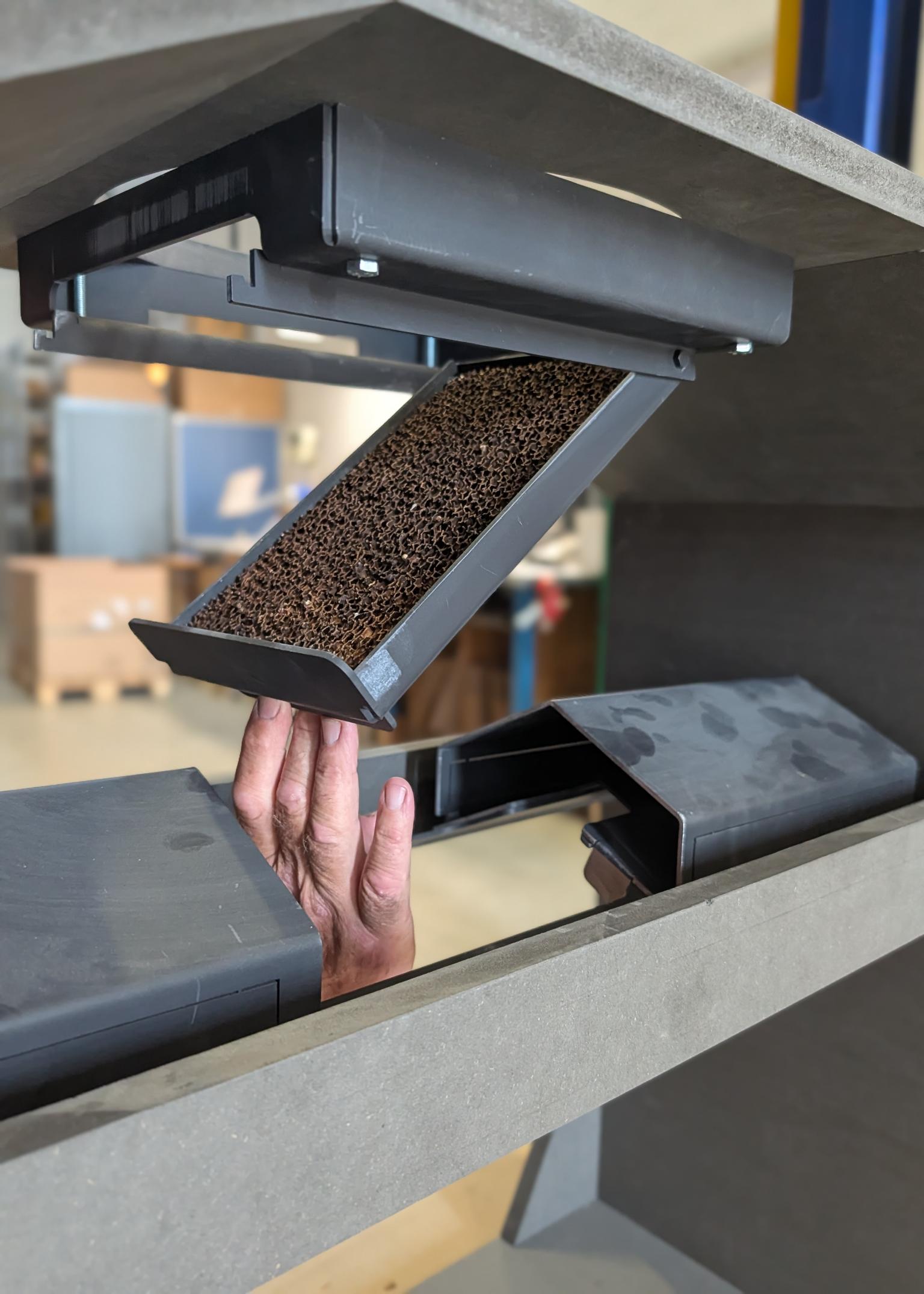
It became clear that using firewood that is too damp (wood moisture content > 35%) in combination with low combustion temperatures can impair the catalyst’s function. In particular during the lighting phase or when combustion is mainly smouldering, incomplete oxidation occurs, which can cause unburnt residues to accumulate in the catalyst. This can reduce flow through the catalyst and its catalytic effect.
However, our tests also show that the catalyst can regenerate under optimal operating conditions. If it is subsequently fired with dry, well-seasoned wood (residual moisture < 20%) and at sufficiently high temperatures, the deposited residues burn off, allowing the catalyst to regain its full functionality.
We therefore strongly recommend using dry firewood (residual moisture < 20%) to ensure lasting emissions reduction through the catalyst and to guarantee trouble-free operation of your fireplace.
Test: Catalyst clogging
Test: Catalyst clogging
Test: Catalyst clogging
Test: Catalyst clogging
Test: Catalyst clogging
Test: Catalyst clogging